CandyMinesweeper
Minesweeper on the SugarCraft stack

Customizable board (width / height / mine count), iterative zero-flood-fill, win / lose detection. Pure-state Board class so every reveal is unit-testable without touching the runtime.
Requirements
PHP 8.3+ with ext-mbstring (the cell-width math behind every glyph) and ext-intl (the locale machinery behind the 16-locale interface). The composer path enforces both transitively through sugar-core's manifest; the standalone phar installs nothing through composer, so the binary preflights them itself and refuses with a named exit-1 message (candy-minesweeper requires ext-mbstring) before the first frame, never a half-rendered board dying on an undefined function.
Install
composer require sugarcraft/candy-minesweeper
./vendor/bin/candy-minesweeper       # play straight from the dependency

# or run the shipped binary from a clone:
composer install
./bin/candy-minesweeper

# or grab the rolling latest phar (rebuilt on every push to master):
wget https://github.com/detain/sugarcraft/releases/download/candy-minesweeper/latest/candy-minesweeper.phar
php candy-minesweeper.phar
Quickstart
./bin/candy-minesweeper                    # 10×10, 12 mines (defaults)
./bin/candy-minesweeper 16 16 40           # positional args: width height mines
// Programmatic:
use SugarCraft\Core\MouseMode;
use SugarCraft\Core\Program;
use SugarCraft\Core\ProgramOptions;
use SugarCraft\Minesweeper\Game;
(new Program(Game::start(width: 16, height: 16, mines: 40),
new ProgramOptions(useAltScreen: true,
mouseMode: MouseMode::CellMotion)))->run();What's in the box
hjkl alongside arrows; cursor clamps at board edges.f flags / unflags the cursor cell; flagged cells can't be revealed by accident.c or middle-click on a satisfied number reveals all unflagged neighbours — mirrors classic left+right chord behavior.microtime(true) internally, but every observable path — the status line and the persisted best times — is whole seconds; frozen on win/lose.CANDY_MINESWEEPER_STATS=/path/stats.json (off by default): DifficultyStats then persists games/wins/best time per difficulty to JSON atomically via sugar-core AtomicJsonFile (flock sidecar, temp + rename) so crashes never corrupt the record. Records ride live clocks only: a savegame restore re-anchors the timer from the file, so restored games still count games and wins but can never set a best time (the brand is monotonic per session). The live clock is wall-clock with no pause — AFK time and laptop sleeps inflate a running game, and one dishonestly slow first entry shadows a preset's minimum until a faster run beats it.isWon = every non-mine revealed; exploded = at least one mine was clicked. O(1) via revealedCount — no grid scan on each move.r reseeds with a fresh layout, preserving the chosen board size.S to write the live board to the single save slot — $XDG_CONFIG_HOME/candy-minesweeper/savegame.json when set, ~/.config/candy-minesweeper/savegame.json otherwise (mode 0600) — and L to restore it. The slot carries the full live mine layout: it is the answer key to the game in progress, so keep the file private if you sync dotfiles. Backed by Board::serialize() versioned JSON; unserialize() re-validates every shape and recomputes the counts, so tampered payloads are refused rather than half-parsed.n — live or on the post-game banner — to choose another board without a shell round-trip: 1-4 start the presets, c opens a digit form (width, height, mines) validated by the same rules as the CLI arguments, refusals included. Plain launch still plays the classic 10×10 board straight away (ruling G5-b), and the whole picker speaks the terminal's locale.Lang::t; LC_ALL/LC_MESSAGES/LANG pick the locale from 16 shipped files.Ui\CustomDifficulty validates rows (2–50), cols (2–50), mines (1 to rows×cols−9) with i18n-aware error messages.NO_COLOR, CLICOLOR=0, or TERM=dumb strips the foreground/background colors through the fleet color authority; the game stays fully playable without them.Source & demos
- Source on GitHub (canonical: the
candy-minesweeper/directory of the monorepo) - Full README
- Runnable examples
- Originally inspired by go-sweep (Go); SugarCraft is developed as a native PHP project.
API
| Class | Method | Description |
|---|---|---|
| Game | start(width, height, mines) | Start a new game (optional $rand, $stats, $statsPath, $notice) |
| Game | withDifficulty(d) | Start with a preset difficulty |
| Game | withCustom(width, height, mines) | Start a custom-sized game; it tallies stats when its dimensions match a preset (via difficulty()) and plays without preset tallies otherwise |
| Game | difficulty() | The Difficulty whose dimensions the board matches, or null for a custom shape |
| Game | savePath() | Absolute save-slot path resolved at call time ($XDG_CONFIG_HOME wins, then $HOME/.config); null when neither is usable, degrading save/load to announced no-ops |
| Game | elapsed() | Elapsed time as float seconds (the status line and stats carry whole seconds) |
| Game | recordResult(elapsed) | Record win/loss and update stats |
| Board | blank(width, height, mineCount) | Empty board; mines placed on the first reveal |
| Board | cell(x, y) | Get cell at position |
| Board | reveal(x, y, rand) | Reveal the cursor cell — places mines on the first call, then floods; no-ops on revealed or flagged cells |
| Board | toggleFlag(x, y) | Flag / unflag a cell; no-ops once the cell is revealed |
| Board | chord(x, y) | Chord-click — reveals the unflagged neighbours of a satisfied number; a mis-flagged mine detonates through the flood |
| Board | isWon() | True when every non-mine cell is revealed (O(1)) |
| Board | flagCount() | Live flag total (tracked incrementally) |
| Board | serialize() | Emit versioned JSON string ({v:1, w, h, m, p, e, r, c}) — the save slot's board payload |
| Board | unserialize(data) | Reconstruct a Board from a serialize() payload, re-validating shapes and recomputing counts |
| Difficulty | enum (Easy/Standard/Medium/Expert) | The four shipped presets; fromDimensions(w, h, m) maps a board shape back to its preset (or null) |
| Stats | pure value object | In-memory games/wins/best time per difficulty — withGame(d, won, time), gamesPlayed(d), wins(d), winRate(d), bestTime(d) |
| Ui\CustomDifficulty | fromInput(rows, cols, mines) | Validate custom board dimensions; throws the translated string via Lang::t on violation |
| Ui\CustomDifficulty | defaults() | Factory — 9×9, 10 mines |
| DifficultyStats | load(path) | Load stats from atomic JSON file (null if absent; RuntimeException on an invalid or unsupported-version file) |
| DifficultyStats | save(path) | Persist stats atomically via AtomicJsonFile (flock + temp + rename) |
| DifficultyStats | withGame(d, won, time) | Return new DifficultyStats with the game recorded |
| DifficultyStats | stats() | Read side as the pure Stats value object |
Demos.
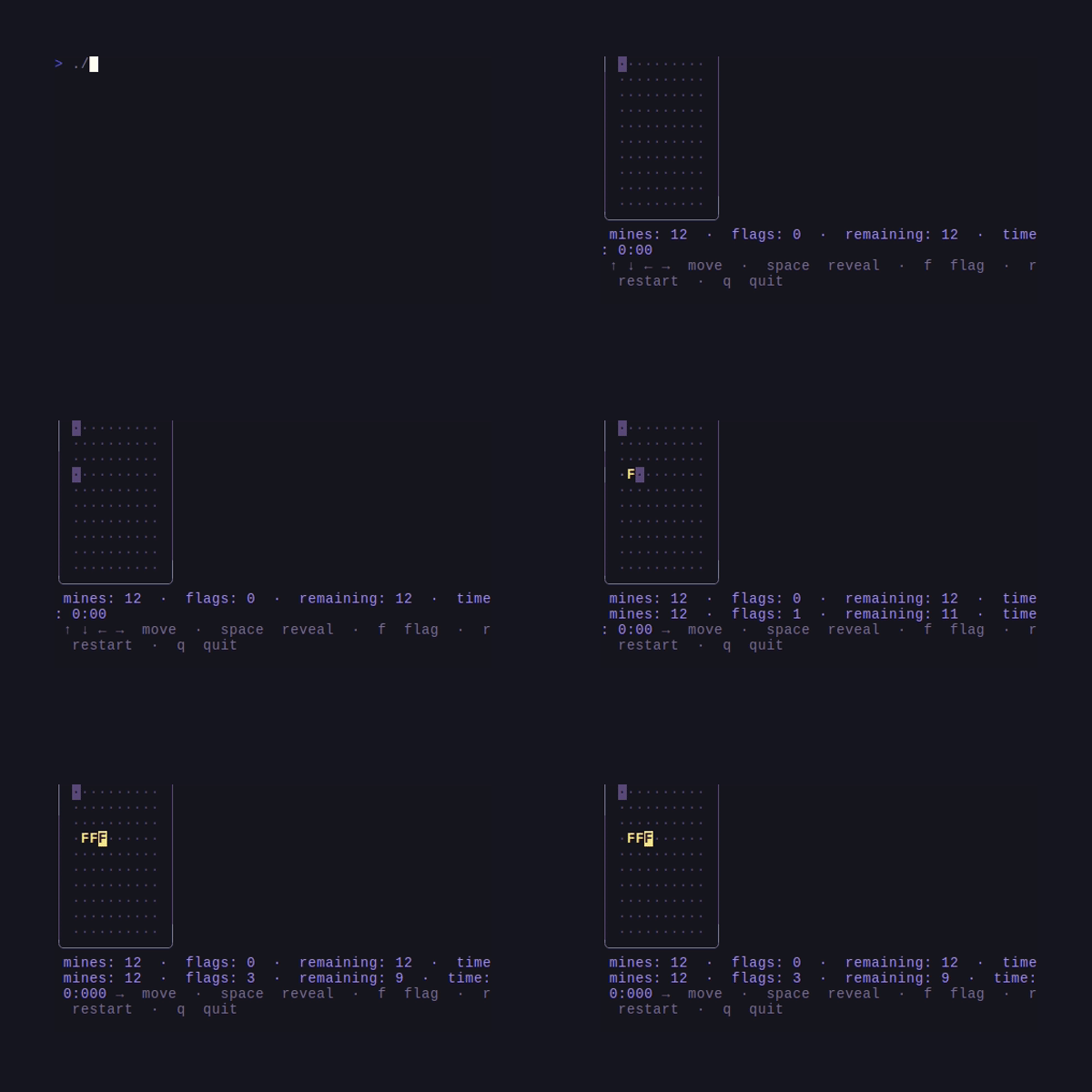
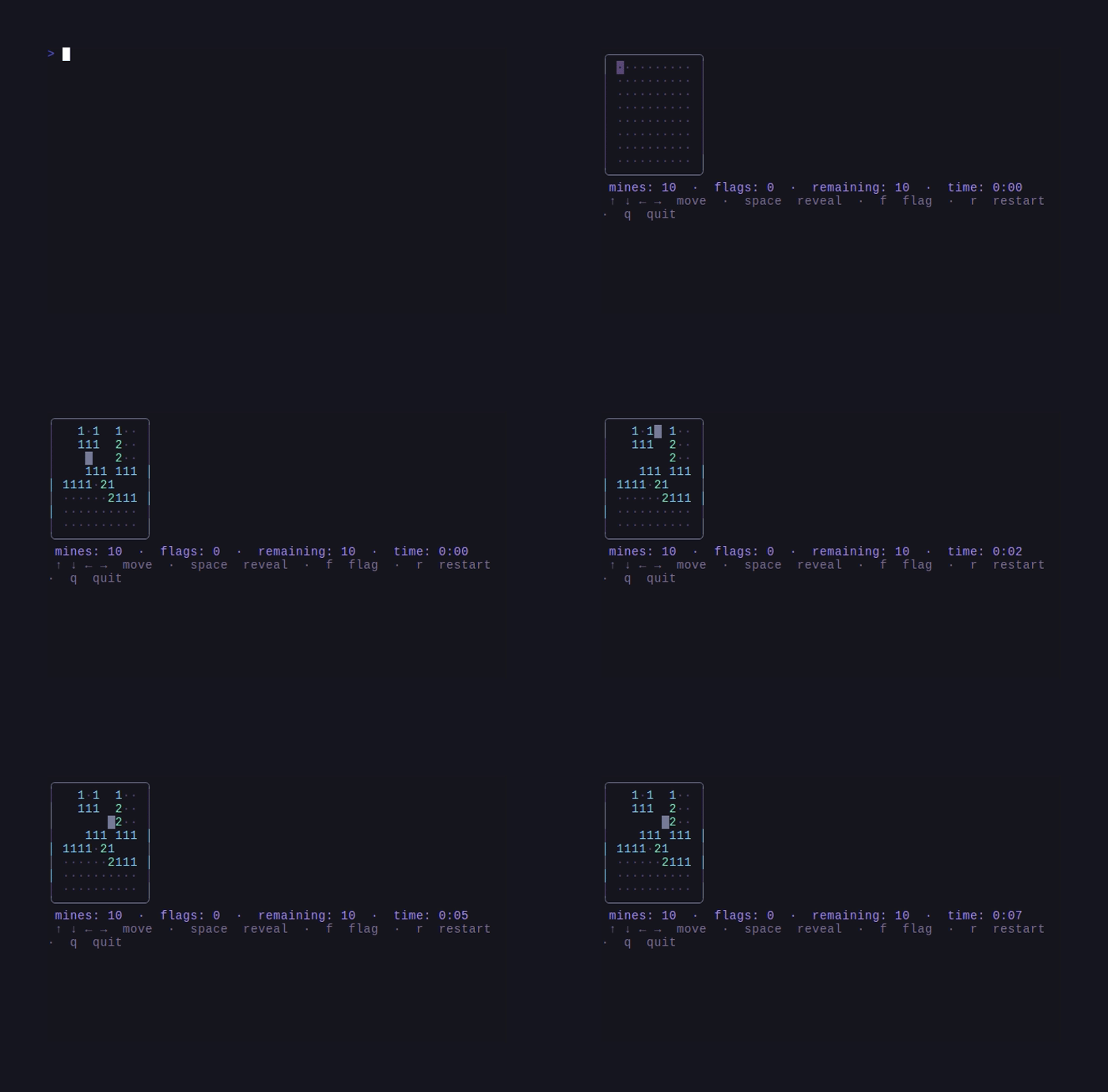
VHS-recorded GIFs of the shipped binary — each tape drives ./bin/candy-minesweeper in a scripted session. Regenerated automatically on every push that touches the source.
Play
Cursor walk, flood-fill reveal, flag plant.