SugarToast
Floating notification overlays

Non-blocking floating notifications at 9 screen positions. Error, Warning, Info, Success types. Auto-dismiss, an Escape-dismiss preference flag for hosts, and stacked multi-toast support. Severity never rides color alone: each type carries a distinct symbol, withAccessibleText() adds the plain-text word, and the REDUCE_MOTION/NO_COLOR environment gates drop blink and color bytes while those text channels keep rendering.
Install
composer require sugarcraft/sugar-toastQuickstart
use SugarCraft\Toast\{Position, Toast, ToastType};

$toast = Toast::new(50)  // max width 50
    ->withPosition(Position::TopRight)
    ->withDuration(10.0);  // seconds

$toast = $toast->alert(ToastType::Success, 'File saved!');
$toast = $toast->alert(ToastType::Error, 'Connection failed');

$bg = str_repeat("background content\n", 20);
echo $toast->view($bg);
What's in the box
withAccessibleText() for a plain-text severity word (box shape and border glyphs are the same across types, so color is never the sole carrier).null $expiresAt at the alert()/progressToast() doors means "use the configured duration" — persistence is reached by keeping the toast duration unset or through the explicit sentinel (withCancelledExpiry(), deprecated alias withoutExpiry(), or cancelAlert()).withAccessibleText().withAccessibleText() names the severity in words and prints progress percentages — a text channel beside the frame's color/glyph language (WCAG 1.4.1) — recommended for any host whose output may be read as plain text (screen readers, copy-paste, log extraction). Default off keeps every frame byte-identical.REDUCE_MOTION/PREFERS_REDUCED_MOTION drop blink; NO_COLOR/CLICOLOR=0 drop all color bytes (renderer palette, custom alert colors, inline message SGR); CLICOLOR_FORCE overrides. The gates are deliberately not spec-literal: a literal NO_COLOR=0 counts as unset (suppression off) and CLICOLOR must read exactly 0 to drop color; the divergence law lives in the color-decision docblock. Environment-only checks — sugar-toast composites for its host and never probes a TTY itself.actionRects()/actionAt() for host-side mouse and keyboard dispatch.history(); clear() never resets it.Source & demos
- Source on GitHub
- Full README
- Runnable examples
- Originally inspired by DaltonSW/bubbleup (Go); SugarCraft is developed as a native PHP project.
API
| Class | Method | Description |
|---|---|---|
| Toast | new(int $maxWidth = 50) | Factory — max width in cells |
| Toast | withPosition(Position) | Set screen position (9 positions) |
| Toast | withDuration(?float $seconds) | Auto-dismiss after N seconds (null = no expiry is armed — alerts persist unless an explicit expiry is given; NAN/INF and values <= 0 throw, the fail-fast door matching withMaxConcurrent) |
| Toast | withAllowEscToClose(bool) | Set the Escape-dismiss preference flag (the renderer handles no input; the host reads it) |
| Toast | withMaxWidth(int) | Set maximum alert width in cells; <= 0 throws (positive cells are the cap; a non-positive width would floor silently to an unreadable 1-cell box) |
| Toast | withMinWidth(int) | Minimum alert width in cells — a master switch: 0 is the FIXED-WIDTH sentinel (box holds its full width cap), any positive value engages fit-content between the floor and maxWidth; only negative throws |
| Toast | withSymbolSet(SymbolSet) | Glyph set — Ascii also swaps the borders to + - | and the progress bar to # . |
| Toast | withMaxConcurrent(?int) | Cap concurrent alerts (null = unlimited; values < 1 throw) |
| Toast | withOverflow(Overflow) | Strategy when cap exceeded: DropOldest, DropNewest, Enqueue |
| Toast | withHostZoneCarry(bool $on = true) | Carry the host's U+E000..U+E001 zone markers through the composite: on (default) keeps every open marker paired (chrome shows holes where a marker was restored); off restores full chrome at the cost of the zone spans |
| Toast | withHistoryLimit(?int $n) | Cap history log, oldest evicted first (default 100; null = unbounded) |
| Toast | alert(ToastType|string, string, ?float $expiresAt = null, ?array $actions = null, ?string $id = null, ?float $ttlSeconds = null) | Add alert; string type = case-insensitive lookup; $expiresAt is an absolute epoch (duration-shaped and non-finite NAN/INF values throw); null inherits the configured duration; $ttlSeconds is a relative lifetime resolved at this door, mutually exclusive with $expiresAt; an $id re-queue updates the live alert in place |
| Toast | progressToast(ToastType|string, string, float $progress, ?float $expiresAt = null, ?array $actions = null, ?string $id = null, ?float $ttlSeconds = null) | Add alert with progress bar (finite 0.0–1.0; out-of-range clamps, NAN/INF throw); same expiry and $ttlSeconds semantics as alert(); re-calling with the same $id advances one box instead of appending |
| Toast | push(Alert $alert) | Enqueue a pre-built Alert (styled/actioned) |
| Toast | cancelAlert(int $index) | Make a queued alert persistent (never auto-dismisses); $index addresses the activeAlerts() order |
| Toast | extendAlert(int $index, float $additionalSeconds) / extendAll(float) | Re-arm one (in activeAlerts() order) / every expiring alert's timer to $additionalSeconds from now — a reset, not a push-back |
| Toast | allowEscToClose(): bool | Read the Escape-dismiss preference flag |
| Toast | error(string, ?float $expiresAt = null, ?array $actions = null, ?string $id = null, ?float $ttlSeconds = null), warning(same tail), info(same tail), success(same tail) | Convenience alert helpers — each carries the full alert() tail (message plus $expiresAt/$actions/$id/$ttlSeconds), delegated verbatim |
| Toast | hasActiveAlert(): bool | Returns true if non-expired alerts are queued |
| Toast | dismiss(), clear(), pruneExpired() | Manage alert lifecycle; dismiss() files EVERY queued alert (expired included) into history, clear() drops without recording, pruneExpired() is silent |
| Toast | history(): list<Alert> | Return all recorded alerts — dismissed, DropOldest evictees AND DropNewest refusals; cumulative, clear() never resets it |
| Toast | view(string $background, int $viewportWidth = 80, int $viewportHeight = 24): string | Composite the toast layer over the background frame; both dimensions must lie in 1..Toast::MAX_VIEWPORT_DIMENSION (4 096 per dimension) and fit Toast::MAX_VIEWPORT_CELLS (a 1 000 000-cell product cap) or an InvalidArgumentException is thrown before any allocation; content that cannot fit ellipsizes instead of vanishing |
| Alert | new(ToastType $type, ?string $message = null, ?float $expiresAt = null, ?float $progress = null, array $actions = [], ?Color $backgroundColor = null, ?Color $foregroundColor = null, ?Color $borderColor = null, bool $persistent = false, ?string $id = null) | Factory mirroring the constructor |
| Alert | $type: ToastType | Severity — drives icon, palette and the accessible label (public readonly) |
| Alert | $message: ?string | User-visible message text (null renders as empty) |
| Alert | $expiresAt: ?float | Absolute seconds-since-epoch instant the alert stops rendering; null means INHERIT — the queueing doors arm the configured withDuration() timer when one is set. Never-expiring is the $persistent sentinel, not null alone |
| Alert | $progress: ?float | Progress 0.0–1.0 (non-finite throws; the constructor stores the value as given — withProgress() clamps on attach and render clamps again); null = no progress bar |
| Alert | $actions: list<Action> | Clickable action buttons |
| Alert | $backgroundColor: ?Color | Box background fill (null = no fill, plain render) |
| Alert | $foregroundColor: ?Color | Message-text color (null = terminal default) |
| Alert | $borderColor: ?Color | Box-glyph (border) color (null = terminal default) |
| Alert | $persistent: bool | Explicit never-expire sentinel: the queueing doors skip duration inheritance while it is set, and isExpired() short-circuits on it — a companion $expiresAt accepted alongside is stored but unread while persistence stands |
| Alert | $id: ?string | Stable identity for update-in-place: re-queuing an alert with the same id through alert()/progressToast()/push() REPLACES the live alert at its queue position instead of appending a second box; null = anonymous, always appends |
| Alert | withProgress(float) | Attach progress bar (finite 0.0–1.0; out-of-range clamps, NAN/INF throw) |
| Alert | withActions(list<Action>) | Attach action buttons |
| Alert | isExpired(): bool | Check expiry |
| Alert | withExpiry(float $duration) | Set expiry from now |
| Alert | withoutExpiry() / withCancelledExpiry() | Make the alert persistent (never auto-dismisses) — withCancelledExpiry() is the canonical door, withoutExpiry() is a DEPRECATED forwarder kept working until 2.x |
| Alert | withExtendedExpiry(float) | Reset the expiry to N seconds from NOW |
| Alert | withBackgroundColor(?Color) / withForegroundColor(?Color) / withBorderColor(?Color) | Per-alert color overrides — null is unstyled (no fill / terminal default), not the type color; the type's color reaches only the icon |
| Action | new(string $label, \Closure(): void $callback) | Factory |
| Action | $label: non-empty-string | User-visible button label (readonly; normalized at construction — inline SGR kept, other control/escape constructs stripped, printable-empty refused) |
| Action | $callback: \Closure(): void | Invoked when action is triggered (readonly) |
| Toast | withTypeRegistry(?AlertTypeRegistry): self | Register custom alert types; string types resolve registry-first, then the built-ins |
| AlertTypeRegistry | new(): self / with(AlertTypeDefinition): self / resolve(string $key): ?AlertTypeDefinition / keys(): list<string> | Immutable registry of custom types (bubbleup RegisterNewAlertType, as a value) |
| AlertTypeDefinition | new(string $key, string $prefix, ?Color $color = null, ToastType $base = Info, ?string $label = null, ?string $asciiPrefix = null): self | Custom type: key, header glyph/prefix, icon colour, base severity; validated at construction |
| HistoryLog | new(array $entries = []): self | Factory mirroring the sibling ::new()s; seeds a log from a list<Alert> (garbage throws, same fail-fast door) |
| HistoryLog | push(Alert, ?int $limit = null): self | Append alert (evicting oldest past $limit), return new immutable log |
| HistoryLog | all(): list<Alert> | Return all recorded alerts |
| HistoryLog | count(): int | Number of recorded entries |
| Toast | activeAlerts(): list<Alert> | The live queue exactly as view() sees it (expired filtered) |
| Toast | removeAlert(string $id): self | Retire the queued alert with this id, unrecorded |
| Toast | actionRects(?string $background = null, ?int $viewportWidth = null, ?int $viewportHeight = null): list<array{action,alert,alertIndex,actionIndex,row,col,width,fold}> | Absolute frame cells of every painted button in the frame on screen — omitted arguments read the last view()'s memo; arguments differing from it throw LogicException instead of silently describing another frame. The expandable [+N more] fold row appears as one extra rect with a non-zero fold (hidden-button count) |
| Toast | frame(?string $background = null, ?int $viewportWidth = null, ?int $viewportHeight = null): ?ToastFrame | The rendered frame as a value: composed rows, top-box x/y, actionRects(), actionAt(), boxRows(); null when nothing renders |
| Toast | actionAt(int $col, int $row, ?string $background = null, ?int $viewportWidth = null, ?int $viewportHeight = null): ?Action | Which Action covers a position of the frame on screen — omitted args read the last render, mismatched args throw (see actionRects); where boxes share rows, the top-most (newest) one wins |
| Toast | withActionsExpanded(int $alertIndex, bool $on = true): self | Expand (or collapse) one alert's [+N more] action fold — activeAlerts() index; out of range is a no-op |
| Toast | expandAt(int $col, int $row, ?string $background = null, ?int $viewportWidth = null, ?int $viewportHeight = null): ?Toast | Mouse door for the fold: the Toast with that alert expanded when the cell is a [+N more] row, else null |
| ToastFrame | foldAt(int $col, int $row): ?int | activeAlerts() index whose fold row covers the cell, or null |
| ToastFrame | boxRows(): list<string> | The composed frame as lines (no trailing-newline artifact) — the full viewport-sized frame; placeAt() yields the box rectangle alone |
| ToastFrame | placeAt(int $col, int $row): ToastFrame | Re-anchor the painted boxes at a host-chosen cell (inset): rows become the boxes' bounding rectangle only, with origin and every hit rect translated |
| Toast | nextExpiry(): ?float / secondsUntilNextExpiry(): ?float | Absolute epoch / seconds until the soonest expiry among queued alerts that carry one (null when none). The scan reads the raw queue, so the instant may be in the PAST (an alert already due but not yet pruned); persistent alerts never appear. |
| Toast | withAccessibleText(bool $on = true) / accessibleText(): bool | Opt-in plain-text severity word + progress percentages beside the color/glyph channel |
| ToastType | Error, Warning, Info, Success | PHP enum cases — toast severity types |
| ToastType | label() / icon(SymbolSet) / nerdIcon() / unicodeIcon() / asciiPrefix() / color() | Translated label via Lang::t() (i18n-aware); per-set glyphs and the default ANSI color |
| Position | xOffset(int $alertWidth, int $viewportWidth): int / yOffset(int $alertHeight, int $viewportHeight, int $stackedHeightBefore = 0): int | Placement maths — xOffset can go negative when the box outgrows the viewport (view() clamps to 0); xOffsetClamped() is the floored form |
| Position | xOffsetClamped(int $alertWidth, int $viewportWidth): int | xOffset() floored at column 0 — the exact column view() paints at |
| Position | TopLeft, TopCenter, TopRight, BottomLeft, BottomCenter, BottomRight, MiddleLeft, MiddleCenter, MiddleRight | PHP enum cases — the 9 screen positions |
| Overflow | DropOldest, DropNewest, Enqueue | PHP enum cases — strategy when maxConcurrent is exceeded |
| SymbolSet | NerdFont, Unicode, Ascii | PHP enum cases — symbol set for alert icons |
| Lang | t(key, params) | Translate a string: 'dismiss', 'count', 'more', 'truncated', 'hidden', 'type.*'. The library itself renders the type.* labels (via ToastType::label()) and the more/truncated fold markers; dismiss/count are convenience strings for host UI and are never emitted by view(). |
Per-alert render size is bounded too: Toast::MAX_MESSAGE_CELLS truncates over-long messages with a visible marker and Toast::MAX_ACTIONS_PER_ALERT folds surplus buttons into an expandable "[+N more]" row (expandAt()) — the full text and action list still ride the Alert into history.
Trust boundary. In a TUI the terminal is a sink: alert text is composited through the cell grid, so raw ESC/OSC/BEL payloads in a message never reach the output stream — only SGR the renderer itself builds does. Inline SGR in a message is honored as styling, so sanitize attacker-authored text (Sanitize::untrusted()) before enqueueing. sugar-mouse PUA zone markers (U+E000/U+E001) in toast text pass through as ordinary glyphs — hosts parsing marked frames must sweep with Sanitize::untrustedForMarkedFrames(); the host's own markers on a marked background frame, and its OSC-8 link runs on rows the toast does not cover, survive compositing. Full contract: docs/TRUST-BOUNDARY.md §1.
Internationalization
Every user-facing string the renderer emits (type labels, the +N more fold, the truncation marker) uses SugarCraft\Toast\Lang::t(). All keys live as bare entries in lang/en.php; the toast lookup namespace is baked into src/Lang.php, not a nesting level inside the arrays.
| Key | Default | Parameters |
|---|---|---|
| type.info / type.warning / type.error / type.success | Info / Warning / Error / Success | — |
| dismiss | Press any key to dismiss | — |
| count | {count} notification(s) | {count} |
| more | +{count} more | {count} |
| truncated | …[truncated] | — |
| hidden | +{count} hidden | {count} |
To localize, copy lang/en.php to lang/<code>.php and translate the values.
Demos.
VHS-recorded GIFs of the flagship examples shipped with the library. Regenerated automatically on every push that touches the source.
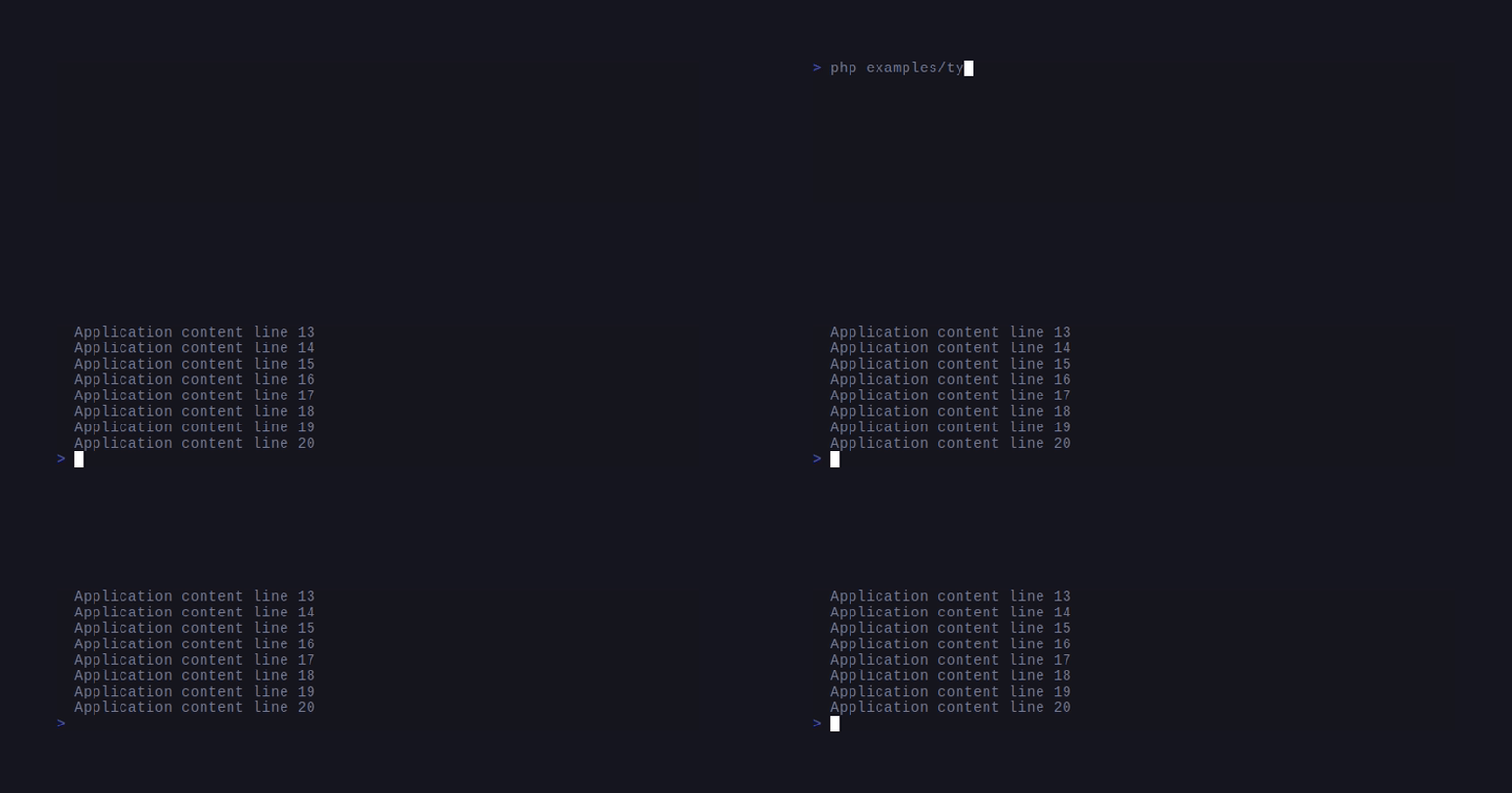
Types demo
Every toast type as its own full-viewport frame, followed by position, configured-duration and symbol-set sections — the duration frames differ only in the printed label: expiry is behavior, not pixels.